Flexible design: Accommodates stators of varying specifications—no custom fixtures or pallets required
Dual heating modes: Supports both induction and electric heating, switchable on demand
Adjustable heating rate: Precisely follows complex heating profiles required by the process
Fully automated operation: Minimizes manual intervention, driving cost reduction and efficiency gains
100,000+ validated process data points: Significantly shortens trial-and-error cycles
Proven at scale: Mature technology ready for mass production
Energy-efficient & eco-friendly: Aligns with green manufacturing standards
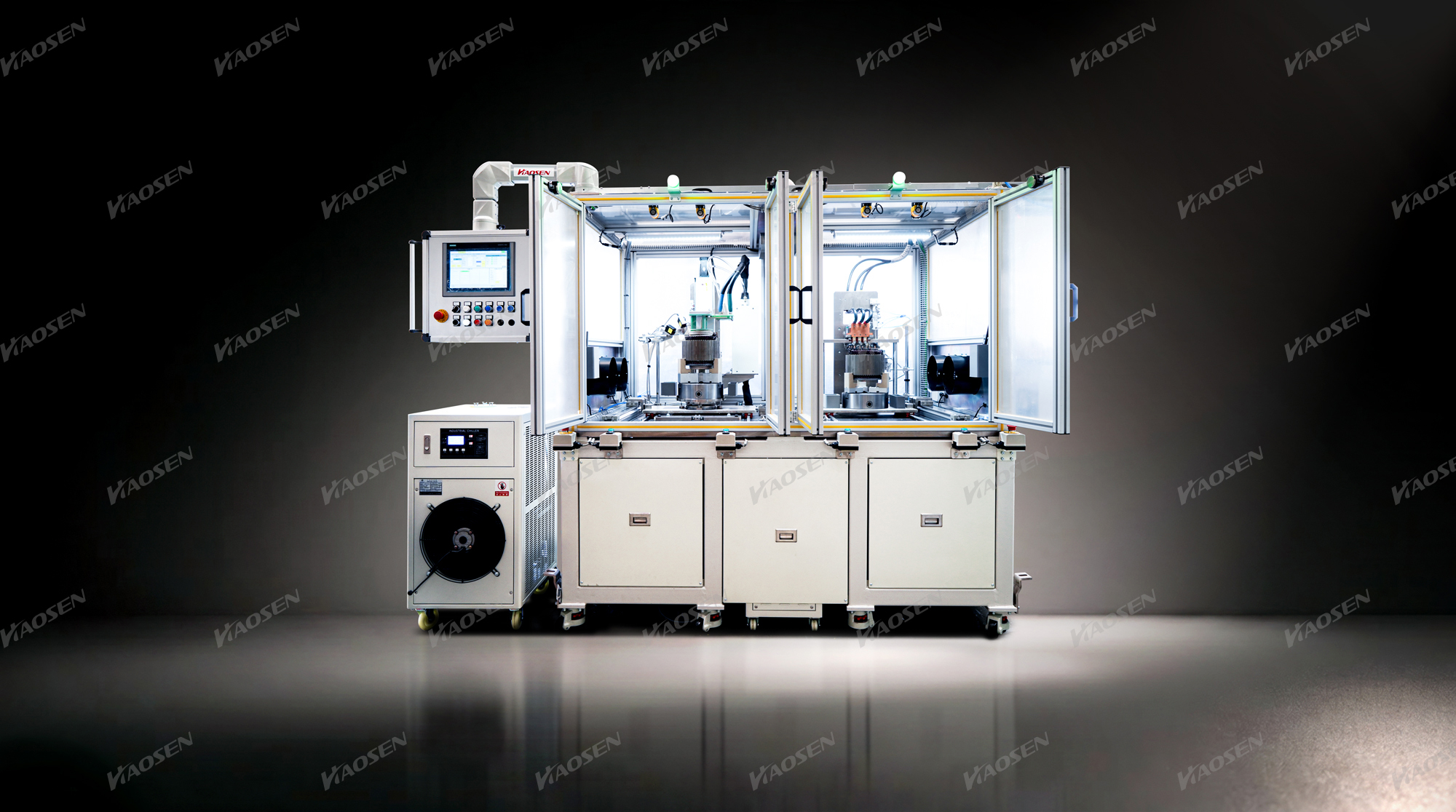
Recently, Haosen has successfully delivered its proprietary Stator Foam Insulation Paper Heating Equipment—a patented in-house development—to a leading global technology company. The equipment has now been commissioned at the client’s key R&D laboratory, where it will play a critical role in material process optimization, performance validation, and global capacity planning.
Responding to Industry Trends:
Addressing New Demands in Drive Motor Insulation
Global interest in green energy is driving technological innovation in the automotive industry. As 800V high-voltage architectures become the core focus of automakers’ new energy technology strategies, drive motor insulation systems must offer higher voltage resistance while also providing filling and structural support to ensure the motor’s reliability and service life. Against this backdrop, foam insulation paper has emerged as the industry’s leading choice due to its superior insulation properties and mechanical strength.
However, the performance of this insulating material is highly dependent on the precision of temperature control during the foaming process. Traditional methods such as tunnel furnace heating and induction heating make it difficult to control the temperature profile and consistency during the self-foaming process, which can easily lead to suboptimal foaming results that fail to meet process requirements and ultimately compromise product performance.
Proprietary Technology:
Dual-Mode Precision Heating System
Haosen is committed to providing the industry with efficient, reliable, and environmentally friendly e-drive solutions through technological innovation and sustainable development. To address the issue of insufficient temperature control precision in traditional heating methods, Haosen has independently developed heating equipment for stator foam insulation paper. This equipment integrates two independent temperature control systems—induction heating and electric heating—which heat the stator winding copper wires to control the temperature rise of the foam insulation paper, thereby ensuring optimal foaming results.
Key Advantages:
This equipment allows for flexible selection between induction heating and electric heating depending on specific heating requirements, and both systems can meet the foaming conditions.
This equipment can heat stator products of varying heights and diameters within a certain range without the need for custom fixtures or pallets. It allows customers to flexibly adjust the heating rate based on production requirements and process parameters, fully meeting the product’s heating profiles.
Equipped with an advanced PLC control system and utilizing PID control technology, this equipment monitors copper wire temperature, voltage, and current data in real time, dynamically adjusting the heating rate of the stator winding copper wires to optimize foaming, adhesion, and curing. The fully automated heating process reduces manual intervention, helping customers lower costs, improve quality, and increase efficiency.
Compared with traditional heating equipment, it offers more precise temperature control and lower energy consumption, effectively reducing energy waste and pollutant emissions, and meeting green production requirements.
Haosen has accumulated over 100,000 process data points during the equipment R&D phase and has extensive experience in mass production. The company can provide customized solutions tailored to the specific characteristics of customers’ products and on-site operating conditions, helping enterprises shorten the trial-and-error cycle associated with introducing new process.
For many years, Haosen has continuously innovated in the insulation process for flat-wire stators, achieving numerous industry-breaking technological breakthroughs. Haosen was the first in China to develop and implement foaming technology for insulation paper. This process allows for the insulation and curing of windings simply by heating the stator to a specific temperature. The mature application of this technology not only reduces or even completely eliminates the need for the varnishing process but also eliminates the risk of varnish clogging the stator yoke and inter-slot oil passages in oil-cooling solutions. It also provides an ideal insulation solution for new paint materials on copper wire—such as PEEK wire—that are difficult to drip under 800V high-voltage architectures. The delivery of this stator foam insulation paper heating equipment once again demonstrates Haosen’s independent technological innovation capabilities and product reliability, further solidifying the company’s leading technological edge in the field of high-end new energy vehicle equipment.
From cutting-edge technological breakthroughs to patents for core equipment, Haosen is driving the development of the new energy vehicle industry with its leading technological capabilities. Looking ahead, Haosen will continue to advance technological innovation and product upgrades, helping customers seize the initiative in the wave of green development and digital transformation with higher-quality equipment and more lean solutions.

